

Liquid rocketry
The Mission
Our Goals
Key values
Rocket spec sheet
- Propellants
- Nitrous Oxide
& Ethanol - Feed system
- Pressure fed
- Engine targets
- 2 kN Thrust &
6 s Burn time - Planned apogee
- 5 km
- Vehicle size
- 11 cm diameter
x 2.3 m length

Flight Vehicle
The Eos rocket
Recovery: the dual-deploy parachute recovery system brings our rocket safely down from apogee.
Avionics and flight firmware: redundant onboard electronics and embedded firmware handle sensing, state estimation, telemetry, sequencing, and parachute deployment during flight.
Tanks and pressurization system: concentric tanks hold the oxidizer and fuel, pressure from nitrous vapor pressure and the inert pressurization system feed the propellants into the injectors.
Valves and fluid control: a nitrous-piloted main valve switches flow into the unlike-doublet impinging injectors, all integrated into one 3D-printed assembly
Combustion chamber: a phenolic ablative liner protects the chamber, and the graphite nozzle accelerates the exhaust to produce 2 kN of thrust
Aerostructure: carbon-composite fins stabilize the rocket, the glass-composite bodytube and nosecone protect the onboard systems from aerodynamic loads
Ground systems
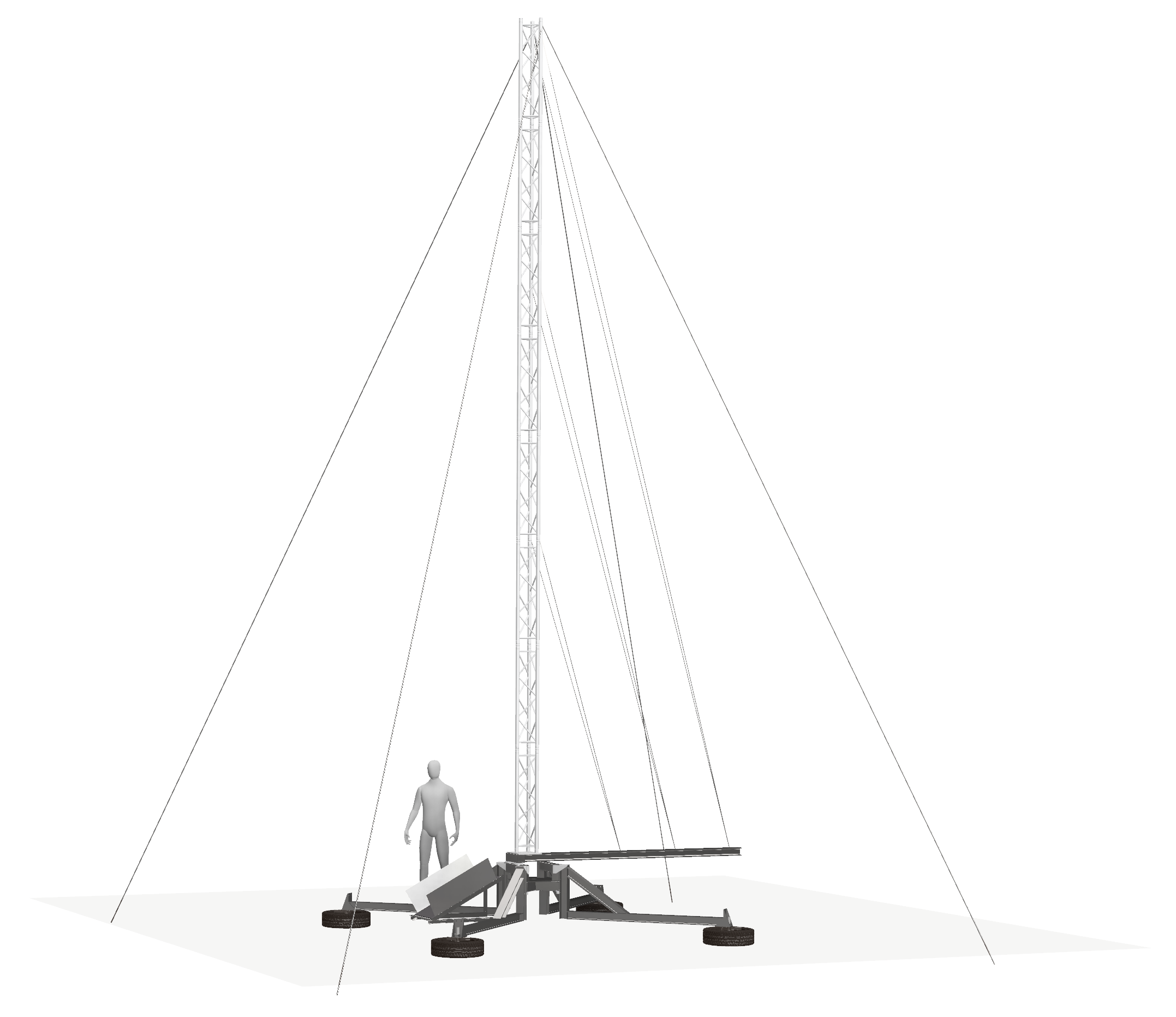
Test stand, launch structure, and ground support equipment
A liquid rocket is only as good as the ground systems that make testing repeatable and launch operations controlled.
- Test and launch structure: the tower design supports horizontal integration and vertical operation, with a raised height of 10 m.
- Ground-side fluid system: tanks, lines, valves, venting, and procedures prepare the vehicle for static fire and launch operations.
Together with the avionics network and fluid handling equipment, the ground segment turns Eos into a complete rocketry program rather than a single engine project.
Electrical and Software systems
Control systems for remote operations
- Ground network: mission control, the launch pad, cameras, and ground fluid systems are all connected over an ethernet network. Modular nodes can actuate valves, read sensors, and power all components with PoE.
- Remote control software: operators monitor sensors and cameras, move valves, and run procedures from a safe distance. Mission control and the launch pad are up to 750 m apart!
- Operations discipline: checklists, telemetry, abort logic, and rehearsals turn high-energy hardware into a controlled test campaign.
Mission in progress
Development milestones
Development Start
Engine Design
Manufacturing & Flight Vehicle Design
Static Fire Campaign
Supersonic Demonstrator
European Rocketry Challenge
Departments as parts of one rocket
Subsystems
Structures
Electrical
Software
Recovery
Propulsion
GSE
Work with us